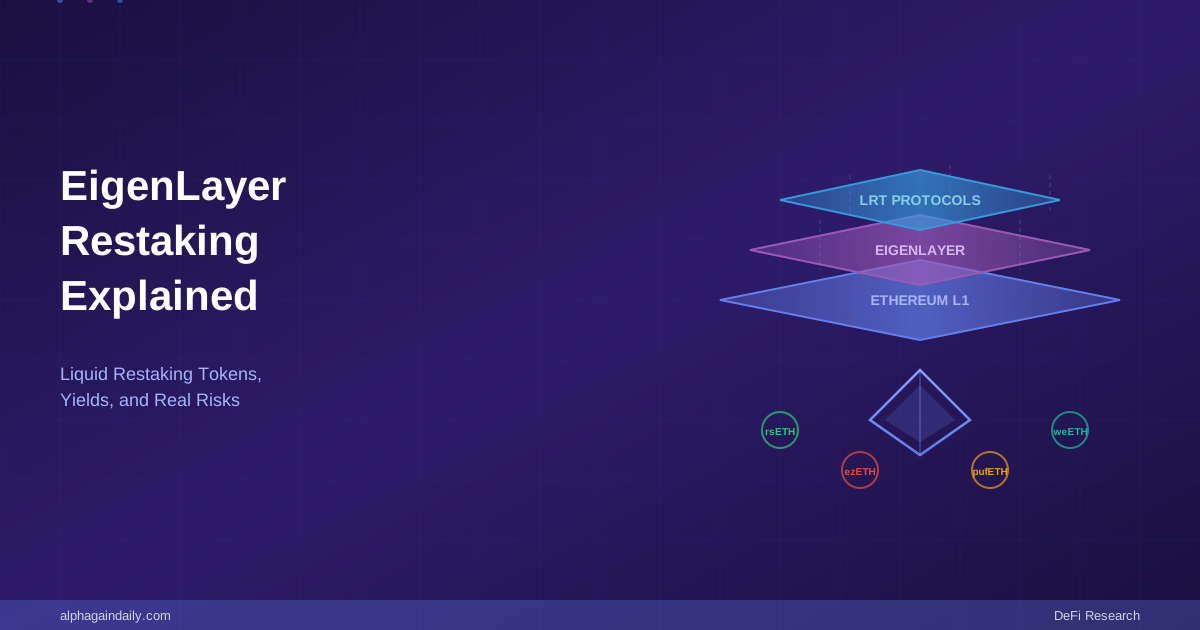
- EigenLayer lets Ethereum stakers restake their ETH to secure additional protocols (AVS), earning extra yield on top of base staking rewards. Total TVL sits around $15.3B as of early April 2026.
- Liquid restaking tokens — weETH (EtherFi), rsETH (Kelp), ezETH (Renzo), pufETH (Puffer). Give you a tradeable receipt so your ETH isn't stuck. They're the main way most people interact with restaking.
- Realistic combined yield: 4-7% APY (base ETH staking + AVS rewards). Airdrop farming returns have declined sharply since major tokens launched.
- Real risks: layered slashing (Ethereum + AVS penalties stack), smart contract exploits across multiple protocols, LRT depeg events, and regulatory uncertainty around restaking derivatives.
- The strategy has matured from airdrop farming into a yield optimization play, still useful, but requires understanding what you're actually securing and what can go wrong.
Table of Contents
- What Is EigenLayer?
- How Restaking Actually Works
- Liquid Restaking Tokens Compared
- Yield Breakdown: What You Actually Earn
- Airdrop Farming: What's Left
- Risks You Cannot Ignore
- How to Start Restaking
- FAQ
What Is EigenLayer?
EigenLayer is an Ethereum middleware protocol created by Sreeram Kannan, a University of Washington professor. The core premise: Ethereum validators have staked roughly $110 billion worth of ETH to secure the network, but that security capital sits idle beyond its consensus duties. EigenLayer lets stakers "restake". Opt in to securing additional protocols simultaneously.
These additional protocols are called Actively Validated Services (AVS). They include oracles, data availability layers, bridges, sequencers, and keeper networks. Each AVS needs economic security to function, and instead of bootstrapping their own validator set from scratch, they tap into Ethereum's existing staker base through EigenLayer.
As of April 2026, EigenLayer has accumulated approximately $15.3 billion in TVL across native ETH restaking and liquid staking token (LST) deposits. Over 20 AVS protocols are live on the platform, with another 30+ in various stages of development.
The EIGEN token launched in late 2024 and currently trades around $2.80. It serves governance functions and is used in EigenLayer's "intersubjective slashing" model. A mechanism for resolving disputes that can't be verified purely on-chain.
Why It Matters for Stakers
If you already stake ETH (directly or through protocols like Lido), restaking offers incremental yield without requiring additional capital. You're essentially renting out your security commitment to more protocols. The catch: each additional AVS introduces new slashing conditions that apply to the same underlying ETH.
For context on base staking yields, see our crypto staking rewards comparison.
How Restaking Actually Works
Understanding the mechanism matters because it determines your actual risk profile. There are three paths into restaking, each with different trust assumptions.
Native Restaking
You run an Ethereum validator node and point your withdrawal credentials to EigenLayer's contracts. Your 32 ETH secures Ethereum consensus AND whichever AVS protocols you opt into. This is the most capital-efficient method but requires technical infrastructure. Roughly 15% of EigenLayer TVL comes from native restakers.
LST Restaking
You deposit liquid staking tokens (stETH, rETH, cbETH) into EigenLayer. The underlying ETH continues earning base staking rewards through Lido, Rocket Pool, or Coinbase, while EigenLayer layers on AVS validation duties. This is simpler than native restaking. No validator node needed. About 35% of TVL uses this path.
Liquid Restaking (via LRT Protocols)
The most popular method. You deposit ETH into an LRT protocol (EtherFi, Kelp, Renzo, Puffer), which handles all the restaking mechanics and gives you a liquid token in return. Approximately 50% of EigenLayer TVL flows through LRT protocols. This is where most retail participants enter.
The Delegation Model
Most restakers don't choose individual AVS to secure. Instead, they delegate to operators, professional node runners who select AVS portfolios on your behalf. Major operators include P2P, Figment, Kiln, and Allnodes. The operator's AVS selection directly affects your yield AND your slashing exposure.
Liquid Restaking Tokens Compared
Four LRT protocols dominate the market. Here's how they differ in ways that actually affect your returns and risk.
| Protocol | Token | TVL (approx.) | Key Feature | Token Status | DeFi Integration |
|---|---|---|---|---|---|
| EtherFi | eETH / weETH | $5.3B | Non-custodial keys; stakers retain validator key ownership | ETHFI live | Deepest (Aave, Pendle, Morpho, 40+ protocols) |
| Kelp DAO | rsETH | $2.1B | Broad AVS diversification across 10+ services | KELP live (Airdrop S2 ongoing) | Good (Pendle, Balancer, major DEXs) |
| Renzo | ezETH | $1.8B | Cross-chain restaking (Arbitrum, BNB Chain, Mode) | REZ live | Moderate (expanding L2 presence) |
| Puffer Finance | pufETH | $1.2B | Secure-Signer anti-slashing tech; lower operator bond | PUFFER live | Growing (Pendle, Morpho) |
A few things the table doesn't show:
EtherFi's weETH has become something of a default in DeFi. It's accepted as collateral on Aave and has the deepest Pendle liquidity pools. If you plan to use your LRT in DeFi strategies (looping, lending, or yield trading on Pendle), weETH gives you the most options.
Kelp's rsETH has the broadest AVS exposure, meaning your restaked ETH secures more services simultaneously. More AVS coverage theoretically means more diversified reward streams, but also more slashing vectors.
Renzo's cross-chain approach means you can restake without bridging to Ethereum mainnet, useful if gas costs are a concern or if you operate primarily on L2s.
Puffer's anti-slashing technology is interesting for risk-conscious participants. Their Secure-Signer runs in a hardware-secured enclave that prevents validators from double-signing, which is the main cause of slashing.
Yield Breakdown: What You Actually Earn
Restaking yield comes from three sources, and conflating them is a common mistake.
Source 1: Base ETH Staking (3.2-3.8% APY)
This is the Ethereum consensus reward. Block proposals, attestations, sync committee duties. It accrues regardless of restaking. Every LRT includes this as a baseline.
Source 2: AVS Rewards (estimated 1-4% APY, highly variable)
Each AVS pays operators and their delegators for securing it. Payments come in the AVS's native token, ETH, or USDC depending on the protocol. As of April 2026, EigenDA (EigenLayer's own data availability service) is the largest AVS by stake. Other notable ones include AltLayer, Omni Network, and Witness Chain.
The variance is large because AVS rewards depend on the specific services your operator selects, how much total stake those services have attracted, and the current value of reward tokens.
Source 3: LRT Protocol Incentives (declining)
Early on, LRT protocols offered bonus points, airdrops, and boosted rewards to attract deposits. EtherFi's Season 1 and 2 airdrops, Renzo's REZ distribution, and Kelp's KELP Miles all fell into this category. These programs have largely wound down or reduced significantly. Don't count on protocol incentives as a sustainable yield component.
Realistic Expectation
For a straightforward LRT deposit with no additional DeFi leverage:
- Conservative: 4-5% APY (base staking + minimal AVS rewards)
- Moderate: 5-7% APY (diversified AVS selection + some ongoing incentives)
- Aggressive (leveraged looping): 10-15% APY, but this introduces liquidation risk, borrow rate risk, and smart contract risk across multiple protocols
For comparison with traditional staking options, see our staking rewards comparison.
Airdrop Farming: What's Left
The restaking airdrop meta peaked in mid-2024 when depositing ETH into LRT protocols netted participants thousands of dollars in token allocations. That window has largely closed. Here's what remains.
Completed Airdrops
- EIGEN (EigenLayer): Multiple seasons, the largest allocation went to early restakers and LST depositors
- ETHFI (EtherFi): Season 1-3 distributions complete, generous to early LPs
- REZ (Renzo): Single distribution, favored early depositors and ezETH holders
- PUFFER (Puffer Finance): Token launched, Season 1 claimed
- KELP (Kelp DAO): Season 1 complete, Season 2 ongoing with reduced multipliers
Remaining Opportunities
New AVS protocols launching on EigenLayer may distribute tokens to restakers who secure them early. Protocols like Lagrange, Hyperlane, and several others haven't launched tokens yet. The expected value per dollar restaked is a fraction of what 2024 participants received, but it's not zero.
Some LRT protocols run ongoing loyalty or points programs with decreasing rewards. Kelp's Season 2 is the most notable active program.
For broader airdrop farming strategies beyond restaking, check our Solana airdrop farming guide.
Risks You Cannot Ignore
Restaking stacks multiple risk layers on top of each other. This section isn't a disclaimer. It's the core analysis that should drive your allocation decision.
Layered Slashing
Regular ETH staking has one slashing condition: don't double-sign. Restaking adds slashing conditions from every AVS you secure. If your operator misbehaves on an AVS (or if an AVS has a buggy slashing mechanism), your ETH gets slashed on top of any Ethereum-level penalties.
The EIGEN token's "intersubjective slashing" model adds another layer: disputes that can't be resolved on-chain are settled through a social consensus mechanism. This is novel and essentially untested at scale.
Smart Contract Risk (Compound)
Your ETH flows through multiple contract layers: the staking protocol (Lido, Rocket Pool), EigenLayer's core contracts, the LRT protocol, and individual AVS contracts. A bug in any layer can result in loss. The April 2024 Renzo ezETH depeg event. Where ezETH briefly traded at a 20% discount to ETH. Demonstrated that even without a smart contract exploit, confidence shocks can cause significant short-term losses.
Liquidity Fragmentation
Four major LRTs plus various LSTs create a fragmented liquidity space. Not all LRTs have deep secondary markets. In a market-wide sell event, you might not be able to exit your LRT position at fair value. Withdrawal queues from EigenLayer itself can take 7+ days.
Regulatory Uncertainty
Staking derivatives, restaking, and liquid restaking tokens exist in a regulatory gray area. The SEC hasn't provided clear guidance on whether LRTs constitute securities. A negative ruling could impact LRT protocols' ability to operate in certain jurisdictions.
Operator Risk
Your yield and slashing exposure depend heavily on which operator you delegate to (or which operators your LRT protocol selects). Operator quality varies. Some run across dozens of AVS with excellent track records; others are less proven. LRT protocols abstract this choice away, which is convenient but means you're trusting their operator selection process.
For more on staking risks in the broader crypto context, see our Babylon Protocol guide covering Bitcoin-native staking risks.
How to Start Restaking
If you've weighed the risks and want to proceed, here's the practical path.
Step 1: Choose Your Entry Method
- Simplest: Deposit ETH into an LRT protocol (EtherFi, Kelp, Renzo, or Puffer) through their dapp. You receive an LRT token. Gas cost: ~$5-15 on mainnet, or use Renzo on Arbitrum for lower fees.
- LST route: If you already hold stETH or rETH, deposit directly into EigenLayer or an LRT protocol that accepts LSTs.
- Native restaking: For those running Ethereum validators, point withdrawal credentials to EigenLayer. Requires technical setup.
Step 2: Decide on DeFi Composability
Once you hold an LRT, you can either hold it passively or deploy it in DeFi:
- Passive hold: Earn base staking + AVS rewards. Lowest additional risk.
- Pendle yield trading: Split your LRT into principal and yield tokens. Allows fixed-rate or leveraged yield positions.
- Lending collateral: Deposit weETH on Aave or Morpho, borrow ETH, and loop back for leveraged restaking exposure. This amplifies both yield and risk.
Step 3: Monitor
Restaking is not set-and-forget. Watch for:
- AVS slashing events (check EigenLayer's operator dashboard)
- LRT depeg warnings (track on-chain liquidity depth)
- Protocol governance changes affecting operator selection or fee structures
Use TradingView to monitor ETH price and LRT token ratios. ETH price drops amplify restaking risk because your collateral value falls while slashing conditions remain unchanged.
Step 4: Tax Considerations
Receiving LRT tokens, earning AVS rewards, and swapping between LRTs may each be taxable events depending on your jurisdiction. The tax treatment of restaking is genuinely unclear in most countries. Keep records of every transaction. Consider consulting a crypto-aware tax professional if your restaking position is significant.
For broader portfolio context on how staking fits into crypto yield strategy, see our Ethena USDe yield guide.
FAQ
What is EigenLayer and how does restaking work?
EigenLayer is an Ethereum middleware protocol that lets ETH stakers reuse their staked ETH to secure additional protocols called Actively Validated Services (AVS). Instead of staking ETH only for Ethereum consensus, restakers opt in to validate other services simultaneously, earning extra rewards. The tradeoff: your staked ETH faces additional slashing conditions from each AVS you secure.
What are liquid restaking tokens and why do they exist?
Liquid restaking tokens (LRTs) are receipts issued by protocols like EtherFi, Kelp, Renzo, and Puffer when you deposit ETH for restaking through EigenLayer. They solve the liquidity problem. Without LRTs, your ETH is locked and unusable. With an LRT like weETH or rsETH, you can trade, lend, or use the token in DeFi while still earning restaking rewards.
What are the realistic yield expectations for EigenLayer restaking?
Base ETH staking yields roughly 3.2-3.8% APY. EigenLayer AVS rewards add an estimated 1-4% on top, depending on which services you secure and how much total stake is allocated. Combined, restakers might earn 4-7% APY in mixed rewards. Leveraged strategies can push this to 10-15% but introduce liquidation risk.
Can I lose my restaked ETH through slashing?
Yes. Restaking introduces layered slashing risk. Your ETH can be slashed for Ethereum consensus violations AND for violations of any AVS you opted into. If an operator you delegate to misbehaves on an AVS, a portion of your restaked ETH can be slashed.
Which liquid restaking token should I choose?
EtherFi (weETH) has the largest TVL (~$5.3B) and deepest DeFi integrations. Kelp (rsETH) offers broad AVS diversification. Renzo (ezETH) focuses on cross-chain restaking. Puffer (pufETH) emphasizes anti-slashing technology. Diversifying across 2-3 LRTs reduces single-protocol risk.
Is restaking airdrop farming still profitable?
The high-return phase is over. Major protocols (EigenLayer, EtherFi, Renzo, Puffer, Kelp) have completed initial token distributions. Remaining opportunities exist in newer AVS protocols and second-round allocations, but expected returns are far lower than early 2024 levels.
TVL figures, yield estimates, and token prices are based on publicly available data as of early April 2026 and are approximate. Restaking carries slashing risk, smart contract risk, and regulatory risk. This is not financial advice. Verify current parameters on protocol documentation before committing capital.