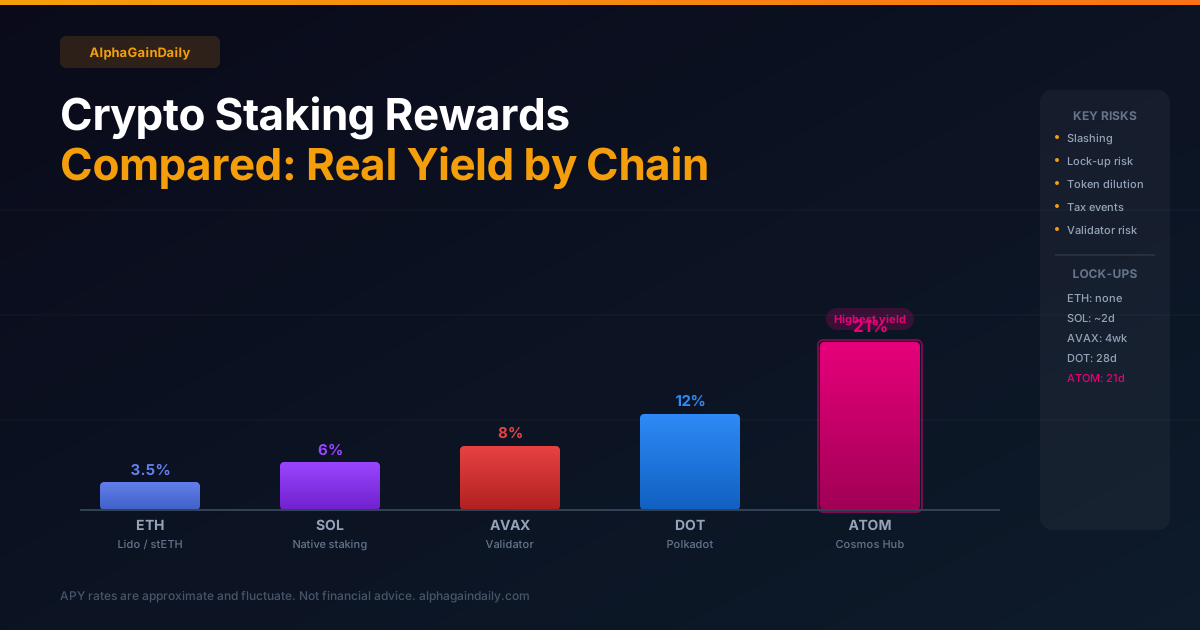
- ETH staking via Lido yields around 3.2-4.5% APY with no lock-up (liquid staking) — lowest headline number, but strongest real yield after inflation
- SOL native staking delivers roughly 6-8% APY with a ~2-day unstaking window. Jito MEV-boosted variants push closer to 7.5%
- ATOM and DOT quote 15-21% and 12-15% respectively, but high inflation rates mean most of that yield is dilution protection, not genuine profit
- ADA staking offers around 3-5% APY with zero lock-up and no slashing. The gentlest on-ramp for cautious stakers, though real yield is thin
- High headline APY does not equal high real returns. Always subtract the chain's inflation rate before comparing.
Table of Contents
- How I Evaluated These Chains
- ETH: The Liquid Staking Standard
- SOL: Short Lock-Up, Decent Spread
- ATOM: High Numbers, Inflation Math
- DOT: Complex Nomination, Long Unbonding
- ADA: No Slashing, No Lock-Up, Modest Returns
- CEX vs Self-Custody vs Liquid Staking
- Side-by-Side Comparison
- The Downsides Nobody Wants to Talk About
- Tax Considerations
- FAQ
How I Evaluated These Chains {#methodology}
Five dimensions, applied to each chain equally:
| Dimension | What I Looked At |
|---|---|
| Nominal APY | Current annualized staking reward rate from stakingrewards.com |
| Real yield | APY minus the chain's annual inflation rate |
| Lock-up period | Time between initiating unstake and accessing funds |
| Slashing risk | Whether validators can lose delegator funds, and how severely |
| Liquid staking availability | Whether you can maintain liquidity while earning yield |
Data pulled from Staking Rewards, official chain documentation, and Dune Analytics dashboards as of March 2026. These numbers shift, sometimes weekly. So verify current rates before committing capital.
One clarification upfront: I hold small staking positions in ETH (via Lido) and SOL. I do not hold ATOM, DOT, or ADA. This does not change the math, but you should know.
If you are building a broader crypto accumulation strategy, staking pairs well with a dollar-cost averaging approach. Staking rewards compound on top of regular purchases.
ETH: The Liquid Staking Standard {#eth-staking}
APY range: ~3.2-4.5% | Lock-up: None via Lido (stETH) | Slashing risk: Low
Ethereum staking through Lido is the most straightforward entry in this comparison. Deposit ETH, receive stETH, earn daily rewards, exit whenever you want. No unbonding period. The 3.2-4.5% APY range is the lowest here. And that is precisely why it is worth understanding.
The APY stays compressed because over 25% of all ETH is currently staked. That much capital competing for block rewards pushes individual yields down. Structurally, this signals deep confidence in the network rather than a problem.
Why the real yield is stronger than it looks: Ethereum's annual issuance sits around 0.5-0.8% of total supply. Compare that to ATOM's 7-20% inflation range. When your staking APY is 3.5% and dilution for non-stakers is under 1%, the gap between stakers and holders is meaningful. You are gaining purchasing power relative to the broader supply, treading water against inflation.
Lido centralization concern: Lido controls roughly 28-30% of all staked ETH. If their validator set were compromised, the ripple effect would be significant. The protocol has responded with governance reforms and validator diversification, but the concentration remains a known structural risk.
Slashing through Lido has historically affected less than 0.1% of staked ETH annually. Lido maintains an insurance fund for such events.
SOL: Short Lock-Up, Decent Spread {#sol-staking}
APY range: ~6-8% | Lock-up: ~2 days (one epoch) | Slashing risk: None (jailing only)
Solana staking roughly doubles ETH's yield with minimal lock-up friction. The unstaking period of one epoch. Around two days, means you are never more than a long weekend away from accessing your funds.
The mechanics: delegate SOL to a validator, earn rewards distributed at epoch end (~2.5 days). Jito's liquid staking variant (jitoSOL) adds MEV-extracted yield that pushes APY to around 7-7.5% depending on network activity. Marinade Finance (mSOL) offers a similar liquid staking derivative.
Validator selection matters more here than most people realize. Solana has over 1,500 active validators with commission rates ranging from 0% to 10%. An unreliable validator with frequent downtime costs you rewards silently. You will not see an error, just lower-than-expected returns at epoch end.
Solana does not slash delegator funds. Validators can be "jailed" (temporarily excluded from earning) for downtime, but your staked SOL is never at risk of being partially destroyed. This makes SOL staking structurally lower-risk on the slashing dimension, though it also means validators have weaker incentives to maintain perfect uptime.
Real yield: With roughly 4-5% network inflation, the ~6-8% nominal APY produces a real yield spread of approximately 1-3%. Not spectacular, but genuinely positive.
ATOM: High Numbers, Inflation Math {#atom-staking}
APY range: ~15-21% | Lock-up: 21 days | Slashing risk: Up to 5% of delegated stake
The biggest number on this list is also the most misunderstood.
Cosmos Hub dynamically adjusts its inflation rate based on how much ATOM is staked. Below 67% staking participation, inflation ramps up toward 20% to incentivize more staking. Above 67%, it eases toward a floor near 7%. The current APY of roughly 15-21% reflects wherever that dial sits at the time you check.
Here is the part that rarely appears in comparison articles: if everyone staking ATOM earns 18% APY in new tokens, the total ATOM supply is also expanding at close to 18%. Stakers are not gaining ground. They are staying level while non-stakers get diluted. The high APY primarily protects you from inflation rather than generating genuine economic yield above the market.
IBC fee revenue (the source of non-inflationary yield) has been modest. ATOM's price trajectory since its 2022 highs has not been kind to long-term holders. The 21% number looks impressive until you work through the total return math across two years.
The 21-day unbonding period is the longest friction cost after DOT. Three weeks with no rewards accruing. In a sharp downturn, that is three weeks of forced holding while watching your position decline.
If you already hold ATOM and believe in the Cosmos ecosystem, staking beats not staking. You avoid dilution. But entering a position specifically because of the 21% headline would be a mistake without understanding the inflation context.
DOT: Complex Nomination, Long Unbonding {#dot-staking}
APY range: ~12-15% | Lock-up: 28 days | Slashing risk: 0.1-100% depending on severity
Polkadot uses Nominated Proof-of-Stake (NPoS), which is the most technically involved staking mechanism on this list. You nominate up to 16 validators. The network's Phragmen algorithm decides which nominations are "active" and earning rewards versus "inactive" and earning nothing.
The inactive nomination problem: Many retail DOT stakers unknowingly sit in inactive status, earning 0% while assuming they are staking productively. If your nominated validators are oversubscribed, your nomination may not be selected. Checking requires tools like Polkadot.js or Subscan. The UX here is genuinely poor for non-technical users.
Nomination pools (introduced to lower the barrier) let smaller holders participate with as little as 1 DOT, distributing rewards proportionally. This helps, but does not fully solve the complexity issue.
28-day unbonding: The longest on this list. Nearly a full month of forced holding with no rewards during the unbonding window. If you spotted an airdrop opportunity that required DOT, you would need to plan almost a month ahead.
Inflation and real yield: DOT's annual inflation runs around 10%, with portions going to validators and the treasury. The 12-15% staking APY roughly tracks inflation, producing modest real yield of 2-5% in nominal token terms, before accounting for DOT price movement.
DOT's slashing penalties can technically reach 100% for coordinated equivocation attacks, though this has never occurred at scale. For typical validator misbehavior, penalties are smaller but still more severe than most other chains.
ADA: No Slashing, No Lock-Up, Modest Returns {#ada-staking}
APY range: ~3-5% | Lock-up: None | Slashing risk: None
Cardano staking is the gentlest mechanism here. Delegate ADA to a stake pool, earn rewards every epoch (~5 days), and your tokens remain fully liquid throughout. There is no unbonding period. You can withdraw or redelegate at any time. Cardano does not implement slashing, so your staked ADA is never at risk of being reduced by validator penalties.
This sounds ideal on paper, and for risk-averse stakers it genuinely is the lowest-friction option. The trade-off is yield: 3-5% APY against Cardano's own inflation of roughly 1.5-3% produces a real yield of barely 1-2%.
Stake pool saturation: Cardano pools have a saturation point (around 68-70 million ADA). Pools above saturation produce diminishing returns for delegators. Choosing an under-saturated pool with consistent performance matters — though the penalty for a bad choice is lower returns rather than lost funds.
Where ADA staking fits: For holders who already own ADA and plan to keep it, staking is an obvious decision. Free yield with no downside risk. For investors choosing a chain specifically for staking returns, the 3-5% APY does not stand out against ETH's similar range plus far deeper DeFi composability.
CEX vs Self-Custody vs Liquid Staking {#staking-methods}
Three ways to stake, each with a distinct trade-off profile:
| Method | Pros | Cons | Yield Impact |
|---|---|---|---|
| CEX staking (Coinbase, Kraken, Binance) | Simple setup, no wallet management, regulated in some jurisdictions | Custody risk (exchange holds your keys), lower APY (platform takes 15-25% cut), withdrawal restrictions | -0.5 to -1.5% vs self-custody |
| Self-custody native staking | Full control of keys, maximum APY, direct validator selection | Technical complexity, must manage validator health, lock-up applies in full | Baseline rate |
| Liquid staking (Lido, Jito, Marinade, Rocket Pool) | No lock-up, DeFi composability (use stETH as collateral), decent APY | Smart contract risk, de-peg risk under stress, protocol fee (~10%) | -0.3 to -0.5% vs native, but with liquidity |
For most people staking under $5,000, a CEX handles the complexity at a reasonable cost. Above $10,000, the cumulative yield difference between CEX and self-custody starts adding up to meaningful dollar amounts. At $50,000+, you probably want self-custody or liquid staking purely on yield math.
A practical middle ground: use liquid staking for your core position (stay liquid, earn near-native yields) and use a DCA calculator to plan regular additions. The staking rewards compound automatically while you add incrementally.
Side-by-Side Comparison {#comparison-table}
| Token | Nominal APY | Inflation | Real Yield | Lock-Up | Slashing | Liquid Staking |
|---|---|---|---|---|---|---|
| ETH | 3.2-4.5% | ~0.5-0.8% | ~2.5-3.5% | None (Lido) | Low (~0.1%/yr) | stETH, rETH |
| SOL | 6-8% | ~4-5% | ~1-3% | ~2 days | None (jailing) | jitoSOL, mSOL |
| ATOM | 15-21% | ~7-20% | ~1-8% | 21 days | Up to 5% | stATOM (Stride) |
| DOT | 12-15% | ~10% | ~2-5% | 28 days | 0.1-100% | vDOT (Bifrost) |
| ADA | 3-5% | ~1.5-3% | ~1-2% | None | None | Limited |
The table shows why headline APY numbers are misleading. ATOM's 15-21% shrinks to as little as 1% real yield in high-inflation periods, while ETH's modest 3.5% delivers a more consistent 2.5-3.5% after accounting for its low issuance rate.
The Downsides Nobody Wants to Talk About {#downsides}
Staking comparison articles tend to present yield numbers without the uncomfortable context. Here are the things that actually matter when you have real money committed:
Slashing is rare but catastrophic when it happens. ETH validators can lose 1/32 of their stake for double-signing. ATOM slashes up to 5% of delegated funds. DOT penalties can theoretically reach 100% for coordinated attacks. These events are infrequent, but if your validator is the one that gets slashed, the APY you earned over months evaporates in a single transaction.
Lock-up periods cost more than you think. The 21-day ATOM unbonding and 28-day DOT unbonding are inconveniences. They are forced holding periods during which you earn nothing and cannot exit. In a market that drops 30% over three weeks, those 21 days represent real, measurable losses that staking rewards do not come close to covering.
Validator selection is not a set-and-forget decision. Validators change commission rates, go offline, get slashed, or become oversubscribed. Particularly on DOT, where inactive nominations earn zero, periodic monitoring is necessary. Most retail stakers do not do this.
Impermanent loss on liquid staking derivatives. stETH and mSOL usually trade near 1:1 with their underlying tokens, but under market stress, they can de-peg. During the May 2022 panic, stETH traded at a roughly 5% discount to ETH for weeks. If you needed to exit during that window, you took a haircut on top of whatever the market did.
You are still exposed to the underlying token's price. A 6% staking yield on SOL means nothing if SOL drops 40% against the dollar. Staking does not hedge price risk. If you are comparing staking yields to, say, a Treasury yielding 4.5% in USD terms, the staking position needs to outperform by the full amount of crypto volatility risk. Sometimes it does. Often it does not.
Opportunity cost is invisible but real. Capital locked in staking cannot participate in airdrop farming, DeFi yield strategies, or simply being available when a sharp buying opportunity appears. The 21-day ATOM unbonding window has historically overlapped with some of the sharpest crypto rallies.
Tax Considerations {#taxes}
Tax treatment of staking rewards varies by jurisdiction, but several patterns are consistent enough to mention:
In most major jurisdictions (US, Australia, UK, Canada), staking rewards are taxable income at the moment of receipt. Not when sold. Daily reward distributions create hundreds of small taxable events per year. The record-keeping burden alone has caused some investors to avoid staking entirely.
Cost basis tracking becomes messy fast. Each reward distribution creates a new tax lot with its own acquisition date and value. If you stake 10 ETH and earn 0.35 ETH in rewards over a year via daily distributions, that is roughly 365 separate tax lots, each with a slightly different cost basis.
Liquid staking may defer the taxable event in some jurisdictions (this is unsettled law). The argument: you received stETH, not ETH. The reward accrues inside the token's value rather than as a separate distribution. Consult a crypto-literate accountant before relying on this interpretation.
For Australian stakers specifically: the ATO treats staking rewards as ordinary income at the AUD market value on the date received. Holding the received tokens for 12+ months before selling qualifies for the 50% CGT discount on any subsequent gain.
FAQ {#faq}
Which crypto offers the highest staking APY right now?
ATOM (Cosmos Hub) currently quotes the highest nominal staking APY at roughly 15-21%. However, most of that yield comes from token inflation rather than genuine economic activity. After accounting for inflation, SOL and ETH deliver better real returns despite lower headline numbers.
Can I lose money staking crypto?
Yes, through three mechanisms: slashing (validator penalties that destroy part of your stake), lock-up risk (token price dropping during unbonding periods when you cannot sell), and opportunity cost (staking APY failing to compensate for token depreciation vs other assets). Staking does not protect against underlying price decline.
What is the difference between nominal APY and real yield in staking?
Nominal APY is the headline staking reward rate. Real yield is what remains after subtracting the chain's inflation rate. A chain offering 18% APY with 15% inflation only delivers around 3% real yield. ETH's roughly 3.5% APY with sub-1% inflation produces approximately 2.5-3% real yield, comparable despite the lower headline number.
Is liquid staking safer than native staking?
Liquid staking removes lock-up risk since you can sell stETH or mSOL at any time, but it introduces smart contract risk and potential de-pegging. During the May 2022 market stress, stETH briefly traded at a 5% discount to ETH. Native staking avoids smart contract risk but locks your tokens for the chain's unbonding period. Neither is strictly safer. They involve different risk trade-offs.
Should I stake on a CEX or self-custody?
CEX staking (Coinbase, Kraken) is simpler but you surrender custody and typically earn 0.5-1.5% less APY due to the platform's cut. Self-custody staking through liquid staking protocols (Lido, Jito, Marinade) preserves ownership and usually yields more, but requires managing wallets and understanding smart contract risk. For amounts under $5,000, CEX convenience may outweigh the yield difference. Above that threshold, self-custody becomes increasingly worth the effort.
APY ranges and inflation figures reflect approximately March 2026 conditions. Staking yields fluctuate with network participation and protocol updates. This article is for informational purposes only and does not constitute financial or investment advice. Verify current rates on stakingrewards.com before making staking decisions.