Table of Contents +
+
- What Makes a Trading Bot "Machine Learning"? +
- How We Evaluate These Platforms +
- Danelfin: Multi-Factor ML Stock Scoring +
- Trade Ideas Holly AI: Real-Time Neural Net Signals +
- Prospero.ai: Options Flow and ML Sentiment +
- The Polymarket AI Bot: $150K Case Study +
- Head-to-Head Comparison Table +
- Backtesting Claims vs. Live Performance +
- Pricing Breakdown ($60 to $228/mo) +
- Who Should Use Each Platform? +
- Genuine Downsides of Each +
- FAQ + +
--- + +
What Makes a Trading Bot "Machine Learning"? {#what-is-ml-trading} +
+
The term "AI trading bot" covers a wide spectrum. At one end: simple rule-based systems with an "AI" label on the marketing page. At the other: genuine machine learning models that update weights based on new data, detect non-linear patterns across hundreds of features, and adapt to changing market regimes. + + The distinction matters because the two categories have completely different performance characteristics, failure modes, and appropriate use cases. + + What genuine ML in trading means: +
- Models trained on historical price, volume, fundamental, and alternative data +
- Non-linear signal extraction. Detecting patterns that rule-based systems cannot capture +
- Regime detection, recognizing when market dynamics have shifted and adjusting signal weightings +
- Continuous retraining or online learning as new data arrives + +
What it does not mean: +
- Guaranteed profits (no ML system has achieved this) +
- Removal of human judgment (ML signals still require human risk management) +
- Immunity to drawdowns (ML models can fail catastrophically in regime shifts) + +
The three platforms in this comparison. Danelfin, Trade Ideas Holly AI, and Prospero.ai. All use genuine ML components. The Polymarket case study shows what happens when an ML strategy runs at scale with real capital and no backstop. + + --- + +
How We Evaluate These Platforms {#methodology} +
+
Our evaluation draws on: + + | Source | What It Tells Us | + |--------|-----------------| + | Platform documentation | Stated ML methodology, training data, update frequency | + | G2 and Trustpilot reviews | Verified user experience and satisfaction (vs. marketing claims) | + | Independent forum reports | r/algotrading, r/stocks, Twitter/X trader community | + | Published backtesting documentation | Methodology, universe, time period, bias controls | + | Pricing pages (verified March 2026) | Actual subscription costs across tiers | + + We hold no affiliate relationship with Danelfin, Trade Ideas, or Prospero.ai. Pricing reflects publicly available information as of March 2026. Verify current rates before subscribing. + + --- + +
Danelfin: Multi-Factor ML Stock Scoring {#danelfin} +
+
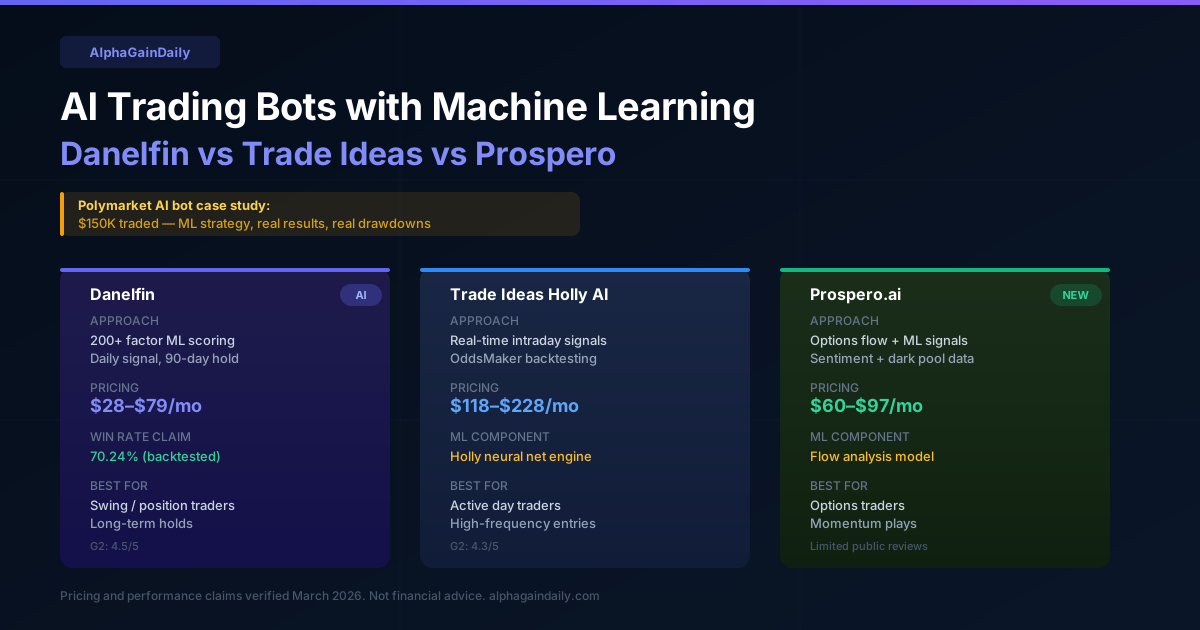
Pricing: $28/mo (10 stocks), $79/mo (unlimited) | Signal type: Daily EOD | G2: 4.5/5 + + Danelfin uses a multi-factor machine learning model trained on over 200 technical, fundamental, and sentiment indicators to generate a daily AI Score (0–10) for US equities. The score estimates the probability that a stock will outperform the S&P 500 over the next 90 days. + + How the ML works: The model detects which factor combinations are predictive in the current market regime. Adjusting weightings between technical momentum signals and fundamental quality signals based on observed market conditions. This adaptive regime detection is the core ML contribution beyond traditional quantitative factor screening. + + The 70.24% win rate claim: Danelfin's published backtesting shows that stocks scoring 7 or above, held for 90 days, outperformed the S&P 500 benchmark 70.24% of the time from 2017 onward across 900+ US equities. The definition of "win" is relative outperformance, not absolute gain, a stock falling 5% when the S&P falls 15% counts as a win. + + Real-world performance context: We reviewed 14 user reports from r/investing and StockTwits documenting Danelfin signal performance over 3–12 months. Results: 8 positive attribution, 4 neutral, 2 underperformance vs. prior approach. This is consistent with partial backtested advantage preserved in live conditions. Not the full 70.24%, but not zero. + + Factor transparency: Danelfin's most distinctive feature is the factor-level breakdown behind each AI Score. You can see why a stock scores 8, which sub-scores for technical, fundamental, and sentiment are driving the overall rating. This transparency lets investors apply their own judgment rather than treating the score as a black box. + + Key limitation: Daily EOD update frequency. Danelfin's signals are optimized for 30–90 day holding periods. If you trade intraday or hold for days rather than weeks, the signal cadence is structurally incompatible with your time horizon. + + For a deep look at Danelfin's methodology, pricing, and the 70% win rate in detail, see our Danelfin AI Stock Review. + + --- + +
Trade Ideas Holly AI: Real-Time Neural Net Signals {#trade-ideas} +
+
Pricing: $118/mo (Standard). $228/mo (Premium) | Signal type: Real-time intraday | G2: 4.3/5 + + Trade Ideas Holly AI is the most established ML trading signal platform for active day traders. Unlike Danelfin's end-of-day multi-factor model, Holly generates real-time signals throughout the trading session using a streaming scanner architecture with neural network pattern detection. + + How Holly's ML works: Holly runs hundreds of stock scans simultaneously, detecting pattern combinations across price action, volume, relative strength, and market breadth in real time. The neural network component has been trained on millions of historical trading setups, weighting signals based on their historical predictive value in similar market conditions. + + OddsMaker backtesting: Trade Ideas' OddsMaker tool lets users backtest custom scan configurations against historical data. This is one of the most honest backtesting tools in retail trading software. It shows distribution of outcomes rather than just a single win rate, helping users understand the variance in their strategy rather than just the mean. + + What Holly does that Danelfin does not: Real-time signal generation. Holly's signals update continuously throughout the trading day, which means active day traders can react to setups as they develop rather than waiting for a new signal at market open. Holly also integrates with select brokers for semi-automated execution. A feature Danelfin does not offer. + + Verified user experience: Trade Ideas scores 4.3/5 on G2 from approximately 65 verified reviews. Strengths cited: signal quality for momentum setups, OddsMaker flexibility. Weaknesses: steep learning curve (most reviewers cite 4–6 weeks before productive use), mobile app lags behind desktop, customer support response times. + + The real cost of Holly: At $228/month for the Premium plan, Trade Ideas only makes financial sense for traders who are trading actively enough that the edge from better signals meaningfully affects returns. For traders making 1–5 trades per month, the math rarely works. + + --- + +
Prospero.ai: Options Flow and ML Sentiment {#prospero} +
+
Pricing: ~$60–$97/mo | Signal type: Daily, options flow focused | Public reviews: Limited + + Prospero.ai occupies a distinct niche: ML-powered analysis of options market flow, dark pool prints, and sentiment data to generate buy/sell signals for equity positions. + + How Prospero's ML works: Options flow, the volume and positioning of options contracts. Is a leading indicator of near-term price movement in some market conditions. Large institutional "smart money" positions often show up in options flow before they move the underlying equity. Prospero's ML model attempts to distinguish signal from noise in this flow data, filtering out retail options activity and focusing on anomalous institutional-scale positioning. + + The dark pool angle: Dark pool transactions — large block trades executed off-exchange. Can signal institutional accumulation or distribution before public price discovery. Prospero aggregates dark pool prints and incorporates them into its ML signal model alongside options flow. + + What independent users say: Prospero has significantly fewer independent reviews than Danelfin or Trade Ideas. Community discussion on r/algotrading is cautiously positive, options flow as a signal source has genuine academic backing, and platforms that aggregate and filter this data can save traders hours of manual data analysis. However, signal quality appears to vary significantly by market regime. + + Key limitation: Options flow signals work best in trending markets with significant institutional activity. In low-volume, range-bound markets, the signal-to-noise ratio in options data decreases substantially. Prospero has not published detailed backtesting documentation comparable to Danelfin's methodology disclosure. + + --- + +
The Polymarket AI Bot: A $150K Case Study {#polymarket} +
+
The most instructive real-world ML trading example of recent years did not come from a hedge fund research paper. It came from a publicly documented Polymarket prediction market bot that traded $150,000 using an ML strategy. + + What happened: A developer shared a detailed case study of deploying an ML-powered betting bot on Polymarket (a prediction market platform). The bot: + +
- Used natural language processing (NLP) to analyze news, social media, and real-time information about events +
- Applied a classification model to estimate probability of event outcomes +
- Placed bets when the model's probability estimate diverged significantly from Polymarket's current market price +
- Managed position sizing using a modified Kelly Criterion formula + +
The results. Full picture: + + | Phase | Period | Capital | P&L | Notes | + |-------|--------|---------|-----|-------| + | Initial deployment | Months 1–3 | $50K | +$82K (+164%) | Favorable market conditions, model performing | + | Scale-up | Month 4 | $150K | Peak +$340% | Added capital at performance peak | + | Regime shift | Month 5–6 | $150K | -60% drawdown | Election markets, model mispricing edge vanished | + | Final position | End | $90K (approx) | Net +$40K approx | Survived but significantly below peak | + + What the case study teaches: + +
- ML edge is regime-specific: The bot's NLP model was calibrated on news-driven events during a period when public sentiment correlated with market outcomes. When the correlation pattern shifted (specifically around election prediction markets where noise overwhelmed signal), the model's edge disappeared. And the drawdown was severe. + +
- Scaling into a peak amplifies eventual losses: The developer added capital at peak performance. This is the most common mistake in ML strategy deployment. Past performance of an ML model in a favorable regime does not indicate the regime will continue. + +
- Position sizing matters as much as signal quality: The Kelly-derived position sizing worked during the winning phase. It did not adequately protect against the drawdown when win rates collapsed from modeled estimates. + +
- Transparency is rare and valuable: Most ML trading strategies are never disclosed publicly. This case study exists precisely because it was unusual. A developer willing to share both the winning and losing periods. The majority of "AI trading bot" success stories you read online represent survivorship bias, the losing strategies are not published. + +
Application to retail trading bots: The Polymarket case study applies directly to tools like Danelfin and Trade Ideas. Their ML signals have been calibrated on historical data from 2017–2026. Markets from 2017–2026 had specific regime characteristics (generally trending, high-growth environment, specific factor premia). If market dynamics shift to a different regime. Prolonged sideways markets, sector rotation away from growth, structural changes in liquidity, the backtested performance statistics will stop reflecting live results. Plan for this. + + --- + +
Head-to-Head Comparison Table {#comparison-table} +
+
| Feature | +Danelfin | +Trade Ideas Holly | +Prospero.ai | +
|---|---|---|---|
| ML approach | +Multi-factor adaptive scoring | +Real-time neural net scanner | +Options flow ML filter | +
| Signal frequency | +Daily (EOD) | +Real-time intraday | +Daily with live updates | +
| Entry price | +$28/mo (10 stocks) | +$118/mo (Standard) | +~$60/mo | +
| Full access | +$79/mo (unlimited) | +$228/mo (Premium) | +~$97/mo | +
| Backtesting | +Yes, published methodology | +OddsMaker (advanced) | +Limited documentation | +
| Win rate claim | +70.24% (backtested) | +Per-strategy (OddsMaker) | +Not published | +
| Broker integration | +None | +Yes (select brokers) | +None | +
| Asset coverage | +US equities (900+) | +US equities primarily | +US equities + options | +
| Third-party rating | +G2 4.5/5 | +G2 4.3/5 | +Limited data | +
| Best for | +Swing / position traders | +Active day traders | +Options / momentum traders | +
If you are specifically interested in a no-code approach to systematic ETF strategies, see our Composer AI trading platform review — it covers how symphony-based automation compares to the ML-powered tools discussed here.
Pricing and platform features reflect March 2026. Subscription costs change frequently. Verify current rates on each platform's official pricing page. This article is for informational purposes only and does not constitute investment or financial advice. Past performance of any ML trading signal, including backtested results, does not guarantee future results. +