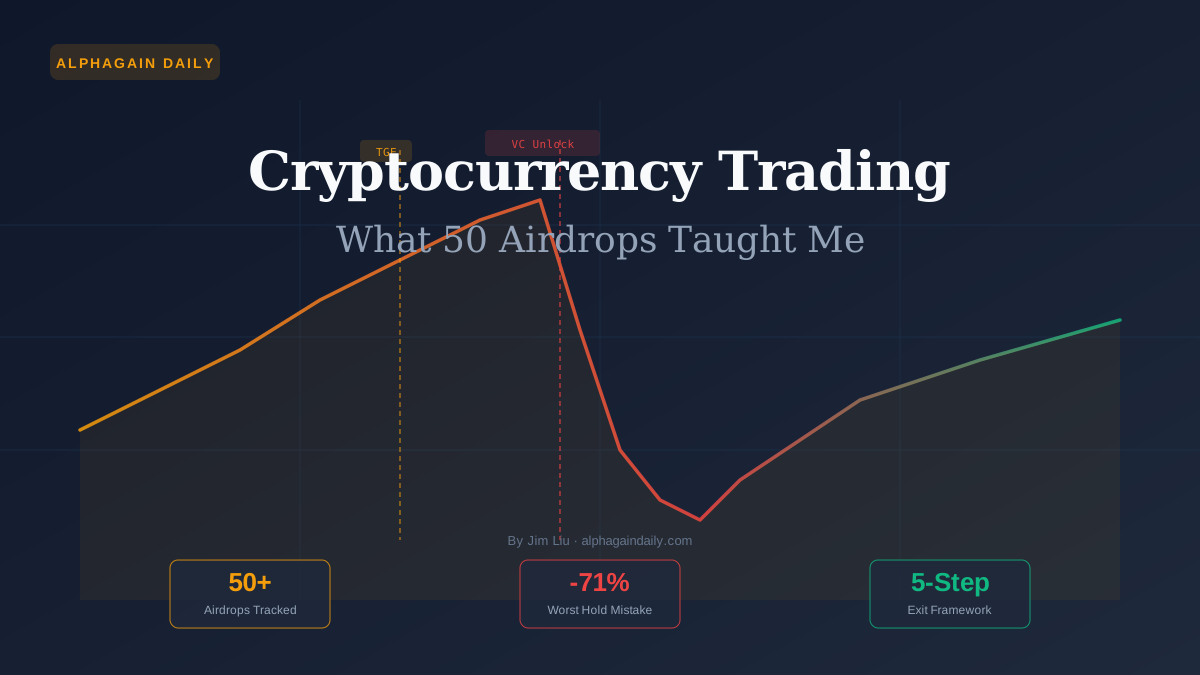
TL;DR
- I'm Jim Liu, founder of AlphaGain Daily — I've tracked 50+ crypto airdrops since early 2024
- In that time I made every classic cryptocurrency trading mistake: held through VC unlock cliffs, averaged down on hopium, exited without a plan
- Core insight: the moment airdrop tokens hit your wallet, you've already made a cryptocurrency trading decision — whether you realize it or not
- My current framework: FDV check → liquidity depth → unlock calendar → market maker signal → sentiment filter (contrarian)
- Bottom line: sell at least 50% within 48 hours of TGE on any new airdrop unless fundamentals are clearly strong and FDV is conservative vs. comparables
Who I Am, and Why I Started Caring About Trading
I'm Jim Liu. I run AlphaGain Daily (alphagaindaily.com), where I research and track crypto airdrops full time.
I got into airdrops in early 2024 — the risk profile appealed to me: complete tasks for a project, receive tokens, sell at TGE. Capital-light, asymmetric upside, or so it seemed.
What I underestimated was the exit problem.
By mid-2024, I'd participated in about 20 airdrops. Three of those should have generated meaningful profits. On all three, I fumbled the cryptocurrency trading side — held too long waiting for "the real pump," sold too early on the first green candle, or had no plan and defaulted to panic decisions.
I eventually started studying basic cryptocurrency trading concepts. Not to become a trader — I still primarily think of myself as an airdrop researcher — but to stop bleeding value on the back half of the process I'd been ignoring.
The Gap Most Airdrop Farmers Have
Most people approach airdrops like scratch tickets: complete the tasks, wait for the reveal, see what you got. The cryptocurrency trading decision that follows is treated as a separate thing — something other people do.
But it isn't separate. Every airdrop exit is a cryptocurrency trading decision. When you decide to "hold and see," that's a position. When you sell half on day one, that's a strategy. When you do nothing while the price collapses, you've still made a choice — just not a conscious one.
Over 50+ airdrops tracked at AlphaGain Daily, I've observed this consistently: participants who understood even basic cryptocurrency trading concepts — how to read tokenomics, what FDV means, how unlock schedules affect selling pressure — captured significantly more value from the same tokens compared to people making decisions based on Discord sentiment or gut feeling.
The good news: you don't need to become a full-time trader. You need to understand about five concepts. Those five concepts change everything.
5 Cryptocurrency Trading Concepts That Changed My Approach
1. Fully Diluted Valuation (FDV) at TGE
This is the single most useful thing I've learned about cryptocurrency trading as it applies to airdrops.
FDV = Initial Token Price × Total Supply.
Before claiming anything now, I calculate the FDV and compare it to projects of similar size and stage. A new L2 launching at a $4B FDV when comparable projects traded at $600-800M at a similar stage? That's arithmetic, not a trading call. The current price has limited realistic upside near-term.
I learned this the expensive way with a restaking protocol airdrop in late 2024. I was focused on how many tokens I'd earned and didn't stop to calculate: at TGE price, my position implied an $11B FDV for a protocol with $380M TVL. I held because the community was "still bullish." The token dropped 71% over the next eight weeks.
2. Unlock Schedules and Real Selling Pressure
Most airdrop tokens come with vesting — your allocation unlocks over months or years. The problem: other allocations (investor tokens, team tokens) often unlock on a similar schedule.
I now read every project's tokenomics document before claiming. Specifically:
- What percentage goes to investors and team?
- When do those unlock relative to my airdrop unlock?
- What's the ratio of liquid supply at TGE to total supply?
A project where VCs hold 25% and their lockup ends the same month my airdrop vests? That's major selling pressure incoming from sellers who bought at a fraction of the TGE price. This is a fundamental cryptocurrency trading risk that isn't obvious if you're not looking for it.
3. Liquidity Depth vs. Trading Volume
High trading volume and deep liquidity are not the same thing. Volume can be high in a thin market — it just means the same small float is changing hands rapidly.
For smaller airdrop tokens, thin liquidity means my sell order can move price significantly. I now check order book depth (buy orders within 2% of current price) before placing any meaningful sell. This is a basic cryptocurrency trading concept most airdrop participants skip entirely.
4. Market Maker Agreements and What Happens When They End
Many high-profile airdrop launches involve market makers — firms paid to provide liquidity and stabilize price, at least initially. MM agreements typically run 3-6 months.
When MM agreements wind down, liquidity can drop suddenly. I've tracked projects where price was stable for 4-5 months post-TGE, then fell 35-50% in a couple of weeks when the market maker stepped back.
Checking for public information about MM arrangements has become part of my airdrop research checklist. If a project explicitly discloses this, I factor the timeline into my cryptocurrency trading decisions around that token.
5. The Post-Announcement Dip Pattern
In cryptocurrency trading, prices frequently run up on speculation before a major event, peak around the announcement, then sell off as early buyers take profits — "buy the rumor, sell the news."
TGE is an announcement. So is the moment airdrops go claimable.
Tracking this across 50+ airdrops at AlphaGain Daily, I've found roughly 65-70% show a price dip of 20-40% within the first 48-72 hours after claim opens. Planning for this as the base case — rather than hoping for an exception — changes how you approach every exit.
My 3 Biggest Cryptocurrency Trading Mistakes
These aren't hypothetical. Each one is real money I watched disappear because I didn't understand what was happening.
Mistake 1: Ignoring the Unlock Cliff (Late 2024)
I received approximately $3,100 worth of tokens at TGE from a DeFi protocol airdrop. Price was already down ~18% from launch price, but Discord was still bullish and I convinced myself the "fundamentals were solid."
What I hadn't checked: a 20% VC allocation with a lockup that expired in 47 days. When it did, price dropped another 58%. My $3,100 worth became approximately $830. I sold there.
What I know now: Any VC unlock within 60 days of my airdrop claim is a significant red flag for near-term cryptocurrency trading. I now model this before claiming.
Mistake 2: Averaging Down Without a Thesis (Early 2025)
An airdrop I participated in dropped 55% from TGE within two weeks. I told myself it was an overreaction and bought more — in a project I had no clear fundamental conviction about, just optimism from the airdrop community.
Price fell another 50% from there. I sold at roughly a 78% loss from my average cost.
What I know now: Averaging down in cryptocurrency trading requires a specific thesis about why the current price is wrong. "The community is still bullish" is not a thesis. "The protocol TVL is growing and this price implies a lower FDV than comparable projects" is a thesis.
Mistake 3: No Price Target Before Claiming
My most consistent early mistake: claim tokens with no pre-defined exit plan, tell myself I'd "figure it out once I see how it trades," then default to emotional decisions when prices moved.
No plan meant panic-selling bottoms that recovered, and holding through collapses waiting for "a little more."
What I know now: Before I claim any airdrop now, I write two numbers: (a) the price at which I'll sell 50% of my position, and (b) the price at which I'm clearly wrong and will exit the remaining 50%. This is basic cryptocurrency trading discipline.
My Current Hold vs. Sell Decision Framework
After 50+ airdrops tracked and the losses described above, here's the actual framework I use for every new airdrop at TGE:
- FDV check: Is the initial FDV reasonable vs. comparable projects at similar stage? If FDV > 5× comparables, sell 75%+ at TGE.
- Liquidity depth: Can I exit my full position in one trading session without moving price more than 3%? If no, split exits over 3-5 days.
- Unlock calendar: Any significant unlocks (VC/team/advisor) within 60 days of my claim date? If yes, sell 70%+ at TGE and set a hard exit date 2 weeks before the unlock cliff.
- Market maker signal: Any evidence of MM agreement? If yes, note the likely agreement duration and use it as a stability window for staged exits. If I can't confirm, assume no MM protection.
- Sentiment filter (contrarian): What's community sentiment at TGE? I track it, then fade it — if Discord is extremely bullish exactly at TGE, that's usually the local top.
This framework doesn't guarantee anything. Cryptocurrency trading has no guaranteed outcomes. But it forces me to make conscious decisions before I'm in the heat of a price move.
Tools I Actually Use
- CoinGecko: Initial FDV calculation, market cap, token supply data
- Token.unlocks.app: Vesting schedules and unlock calendars — this site has prevented me from holding through at least two major VC unlock events
- DefiLlama: TVL and protocol metrics for evaluating DeFi project fundamentals
- Etherscan / Solscan: On-chain wallet distribution to check concentration risk
- AlphaGain Daily (my own site): My primary research database for tracking tokenomics and airdrop fundamentals
FAQ
Do I need to learn cryptocurrency trading to participate in airdrops?
You don't need to become a trader. But you do need to understand FDV, unlock schedules, and liquidity basics to make informed exit decisions. Without those, your returns from even good airdrop allocations will be inconsistent.
Is it better to sell all airdrop tokens immediately at TGE?
Not always. Some airdrops are undervalued at TGE and run significantly in the first week. The framework I use tries to balance this: sell a meaningful portion early to lock in value, keep a portion with a pre-defined exit target. I almost never hold 100% through the first 72 hours anymore.
How do I learn cryptocurrency trading basics without risking real money?
Start with tokenomics — study the economics of 10-15 past airdrops using Token.unlocks.app and CoinGecko historical data. See how FDV at TGE correlated with subsequent price action. This teaches you more than paper trading simulations because it's real data from the exact market you'll operate in.
Why do most airdrop tokens drop after TGE?
Multiple pressures converge: airdrop farmers selling to lock in gains, pre-TGE buyers taking profits, and sometimes market makers stepping back. In cryptocurrency trading terms, TGE is a classic "buy the rumor, sell the news" event. Planning for this as the base case changes how you approach every exit.
How much of my position should I sell at TGE?
My current base rule: at least 50% within the first 48 hours, regardless of initial price action, unless the FDV is clearly conservative by comparable standards and the unlock schedule is clean. This "pay yourself first" approach has been consistently better for my overall returns than trying to time perfect exits.
How I Formed These Views (Methodology)
These observations come from personally tracking 50+ crypto airdrops between early 2024 and May 2026 at AlphaGain Daily. For each project, I document tokenomics at launch, TGE price, and price trajectory over the subsequent 90 days.
My hold vs. sell framework was developed through iteration, not theory — the three mistakes I describe above are real positions I held with real capital. The 65-70% post-TGE dip pattern is from my own tracking log, not a published study.
I'm not a licensed financial advisor. This article describes my personal approach and is not investment advice. Cryptocurrency trading involves significant risk of loss. Your situation is different from mine; your decisions should reflect your own research and risk tolerance.
About the Author
Jim Liu is the founder of AlphaGain Daily (alphagaindaily.com), a crypto airdrop research platform based in Sydney. He has tracked 50+ crypto airdrops since 2024 and writes about tokenomics, airdrop strategy, and the cryptocurrency trading fundamentals that matter most for airdrop participants.