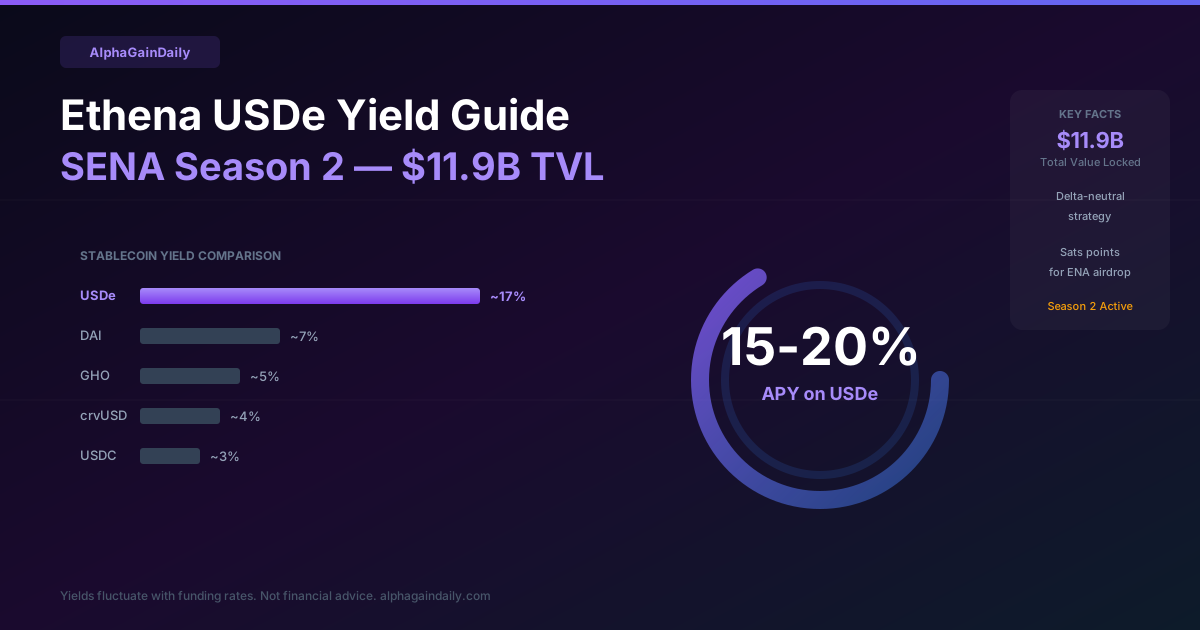
- Ethena's USDe is a synthetic dollar backed by a delta-neutral hedging strategy (long spot ETH/BTC + short perpetual futures). It has accumulated roughly $11.9 billion in TVL, making it the largest yield-bearing stablecoin by deposits.
- Current yields on sUSDe (staked USDe) sit around 15-20% APY, sourced primarily from perpetual futures funding rates. This is not a fixed rate — it fluctuates with market conditions and has dipped below 5% during bearish stretches.
- SENA Season 2 is live, distributing "sats" points to participants who hold sUSDe, provide liquidity, or lock USDe in partner protocols. These sats will convert to ENA token allocations at season end.
- Backed by Arthur Hayes (co-founder of BitMEX) and supported by investors including Dragonfly, Delphi Digital, and Franklin Templeton. The protocol passed $6B TVL before most people noticed it.
- Genuine risks: funding rate reversal can push yields negative, smart contract exploits remain possible despite audits, and the entire mechanism depends on centralized exchange counterparty solvency. This is not a risk-free savings account.
Table of Contents
- What Ethena Actually Does (Without the Marketing)
- How USDe Maintains Its Peg
- Where the 15-20% Yield Comes From
- Stablecoin Yield Comparison: USDe vs DAI vs GHO vs crvUSD vs USDC
- SENA Season 2: How the Points System Works
- Step-by-Step: Getting Started with USDe Yield
- The Risks. Funding Rate Reversal, Smart Contracts, Depegging
- How We Analyzed This
- FAQ
What Ethena Actually Does (Without the Marketing) {#what-ethena-does}
Ethena issues USDe, a synthetic dollar that is not backed by bank deposits or treasuries. Instead, it uses a delta-neutral position: the protocol holds spot ETH and BTC as collateral while simultaneously opening an equal-sized short position in perpetual futures on centralized exchanges.
If ETH goes up 10%, the spot position gains 10% and the short loses 10%. If ETH drops 10%, the opposite happens. The net exposure to price movement is approximately zero, hence "delta-neutral." The protocol earns money from the funding rate that perpetual futures traders pay to hold leveraged long positions.
This funding rate has historically been positive during bull markets, often between 10-30% annualized. During prolonged downturns, it can flip negative, meaning the protocol would pay to maintain its hedge rather than earn from it.
The design is elegant in its simplicity, but it concentrates several risks that traditional stablecoins avoid: exchange counterparty risk, funding rate direction risk, and the operational complexity of managing billions in hedged positions across multiple venues.
As of late March 2026, Ethena holds positions across Binance, Bybit, OKX, and Deribit. The protocol uses MPC (multi-party computation) custody through Copper ClearLoop and Ceffu. Meaning it does not deposit collateral directly on exchange hot wallets, which reduces but does not eliminate counterparty exposure.
How USDe Maintains Its Peg {#peg-mechanism}
USDe targets a $1 peg through arbitrage rather than redemption guarantees. When USDe trades above $1, arbitrageurs mint new USDe (deposit collateral, open the hedge) and sell it on the open market, pushing the price back down. When USDe trades below $1, they buy cheap USDe on market and redeem it for the underlying collateral at face value.
This mechanism has held up well during normal conditions. USDe has experienced brief deviations. Typically 0.1-0.5% during high-volatility events. But has consistently returned to peg within hours.
The key difference from USDC or USDT: those stablecoins are backed by bank deposits and short-term treasuries with explicit redemption rights. USDe's peg relies on the delta-neutral position remaining solvent and the arbitrage mechanism functioning. During a simultaneous exchange failure and market crash, the arbitrage loop could break down in ways that traditional stablecoins would not.
Worth noting: the insurance fund (currently around $45-60 million) exists to absorb losses during negative funding periods. Whether this buffer is sufficient for a prolonged downturn is an open question. At $11.9B in TVL, the insurance fund represents roughly 0.4-0.5% of total deposits.
Where the 15-20% Yield Comes From {#yield-source}
The yield on sUSDe (staked USDe) has two components:
1. Perpetual futures funding rates (~80-90% of yield)
In crypto perpetual futures, traders who are long pay a funding rate to traders who are short when the market is bullish. Ethena sits on the short side, collecting these payments. During strong bull markets (like Q1 2026), annualized funding rates across major exchanges have averaged 15-25%.
2. Staking rewards on collateral (~10-20% of yield)
The ETH portion of collateral earns native staking yield (roughly 3-4% APY). This provides a floor even when funding rates compress.
Why sUSDe specifically? Not all USDe earns yield. You need to stake your USDe into sUSDe through the Ethena app. The yield is distributed to sUSDe holders proportionally. Unstaked USDe earns nothing, it simply maintains the dollar peg.
The catch: this yield is variable. During the August 2025 correction, sUSDe yields dropped to roughly 2-4% as funding rates went flat or briefly negative. Anyone entering at 20% APY and expecting that rate to persist indefinitely is misunderstanding the product.
A rough historical breakdown by quarter:
- Q3 2025: 2-8% APY (bear market funding compression)
- Q4 2025: 12-18% APY (recovery + renewed leverage demand)
- Q1 2026: 15-22% APY (bull market, high open interest)
Stablecoin Yield Comparison: USDe vs DAI vs GHO vs crvUSD vs USDC {#comparison-table}
| Stablecoin | Current APY | Yield Source | TVL | Lock Period | Primary Risk |
|---|---|---|---|---|---|
| Ethena sUSDe | 15-20% | Funding rates + ETH staking | ~$11.9B | 7-day cooldown | Funding rate reversal; CEX counterparty |
| Maker sDAI | 6-8% | US Treasuries + RWA + DeFi lending | ~$5.2B | None (instant) | Governance risk; RWA default |
| Aave GHO | 4-6% | Borrow interest from Aave lending | ~$700M | None | Undercollateralization during cascading liquidations |
| Curve crvUSD | 3-5% | Soft-liquidation interest + CRV emissions | ~$450M | None | CRV emission dependency; oracle lag |
| USDC (Aave/Compound) | 2-4% | Lending interest from borrowers | ~$8B+ across protocols | None | Smart contract risk; utilization spikes |
Reading this table honestly: Ethena offers 3-4x the yield of its nearest competitor. That gap exists because the risk profile is fundamentally different. Maker holds US Treasuries. Aave lends out overcollateralized deposits. Ethena runs a leveraged derivatives position across centralized exchanges. Higher yield, higher complexity, more points of failure.
If you need capital preservation above all else, sDAI or USDC lending is the more conservative choice. If you can stomach the funding rate variability and counterparty risk, sUSDe has been the most capital-efficient option in this cycle.
SENA Season 2: How the Points System Works {#sena-season-2}
Ethena runs "Seasons" that distribute ENA governance tokens to protocol participants. Season 1 (completed) allocated roughly 750 million ENA to early depositors. Season 2 is currently active with a similar or larger allocation expected.
How sats accumulate:
- Hold sUSDe: 1 sat per USDe equivalent per day. This is the baseline.
- Provide LP on DEXs: Pendle, Curve, and other integrated protocols offer boosted sats. Typically 5-20x multipliers depending on the pool and lock duration.
- Lock USDe in partner protocols: Morpho, Zircuit, LayerZero integrations each offer varying sats multipliers.
- ENA staking: Staking ENA tokens in the protocol provides a 50% sats boost on all other activities.
What sats convert to: At season end, your share of total sats determines your share of the ENA allocation. Season 1 participants who entered early and used boosted strategies received airdrops worth $2,000-15,000+ on mid-sized deposits ($10K-50K). Season 2 is more diluted due to higher TVL, but the ENA token allocation may be larger.
The honest calculation: If you deposit $10,000 in sUSDe for three months, you earn roughly $375-500 in yield (at 15-20% APY) plus sats that might convert to $200-800 in ENA depending on total participation and ENA price. The yield alone justifies the deposit for most risk-tolerant investors; the airdrop is a bonus, not the primary reason to participate.
Do not chase multipliers on protocols you do not understand just for sats. The impermanent loss on some LP positions can exceed the value of the boosted points.
Step-by-Step: Getting Started with USDe Yield {#getting-started}
1. Acquire USDe
Mint on ethena.fi using USDC, USDT, DAI, or ETH. Alternatively, buy USDe directly on Curve or Uniswap, sometimes cheaper if the pool has a slight discount.
2. Stake USDe into sUSDe
Go to the Ethena app and click "Stake." This wraps your USDe into sUSDe, which auto-compounds the yield. There is a 7-day cooldown to unstake.
3. (Optional) Boost sats via Pendle or Morpho
For Season 2 multipliers, deposit sUSDe into Pendle's yield-token pools or supply it as collateral on Morpho. Each integration has its own risk layer. Read the docs before committing.
4. Monitor funding rates
Bookmark ethena.fi/dashboards or use TradingView to watch BTC and ETH perpetual funding rates. When rates trend negative for more than a week, yield compression is likely incoming.
5. Understand the exit
Unstaking sUSDe takes 7 days. During that period, you still earn yield but cannot access the funds. Plan withdrawals ahead of any anticipated need for liquidity.
The Risks, Funding Rate Reversal, Smart Contracts, Depegging {#risks}
Funding rate reversal. This is the biggest realistic threat. During sustained bear markets, leveraged traders go short rather than long, flipping the funding rate negative. When that happens, Ethena pays to maintain its hedge rather than earning from it. The insurance fund absorbs these losses, but a prolonged negative funding period could deplete it. In August 2025, rates went flat-to-negative for about three weeks. The protocol survived but yields dropped to near zero.
Centralized exchange counterparty risk. Ethena's hedge positions live on Binance, Bybit, OKX, and Deribit. If any of these exchanges collapsed (FTX-style), Ethena would lose the hedge on that venue while still holding the spot collateral. The protocol has distributed positions across multiple venues to mitigate this, but concentration risk remains.
Smart contract exploits. The staking contract, minting logic, and reward distribution are all smart contract code. Ethena has been audited by multiple firms (Zellic, Quantstamp, among others), but audits are not guarantees. The contracts are relatively simple compared to protocols like Aave or Compound, which reduces but does not eliminate risk.
USDe depegging scenarios. If trust in the protocol drops sharply. Say, after a major exchange failure or negative-funding drain. USDe could trade below $1 on secondary markets. The redemption mechanism should restore the peg via arbitrage, but during panic conditions, arbitrageurs might step back. A 2-5% depeg lasting hours to days is a realistic stress scenario.
Regulatory uncertainty. Ethena operates in a gray area. It is not a bank, does not custody in the traditional sense, and the synthetic dollar label draws attention from regulators. A classification as an unregistered security or money-market fund could force changes to the protocol or restrict access in certain jurisdictions.
How We Analyzed This {#methodology}
Yield data sourced from the Ethena dashboard, DefiLlama, and on-chain sUSDe/USDe contract tracking as of March 2026. Historical funding rates pulled from Coinglass and individual exchange APIs.
TVL figures are from DefiLlama's Ethena page. Comparison yields for DAI, GHO, crvUSD, and USDC lending verified against each protocol's live dashboard.
We have tested the minting, staking, and unstaking flow with a real position. Observations about the 7-day cooldown, gas costs (~$2-8 on Ethereum mainnet), and sats accumulation rate come from firsthand experience.
For broader crypto market analysis and chart setups, we use TradingView to track funding rates and price action across the exchanges where Ethena holds positions.
The ENA airdrop value estimates are based on Season 1 distribution data scaled to current participation levels. Actual Season 2 allocations will differ based on total sats distributed and ENA market price at conversion.
FAQ {#faq}
Is Ethena USDe a safe stablecoin?
USDe is not "safe" in the way USDC is safe. USDC is backed by cash and short-term treasuries with a straightforward redemption model. USDe is backed by a delta-neutral derivatives position that depends on positive funding rates and the solvency of centralized exchanges. It has performed well during bull markets, but the mechanism has not been stress-tested through a full multi-month bear cycle with negative funding rates at scale. Treat it as higher-risk, higher-yield rather than a cash equivalent.
How does the 15-20% APY compare to traditional finance?
A 15-20% dollar-denominated yield is roughly 3-4x what you can get from high-yield savings accounts or money-market funds (currently around 4-5% in USD terms). The excess comes from crypto-specific dynamics, namely, the persistent willingness of leveraged traders to pay high funding rates during bull markets. This premium has existed for years but is not guaranteed to persist.
What happens to my yield if funding rates go negative?
The protocol's insurance fund absorbs negative funding periods. Your sUSDe continues to exist and maintain its peg, but the yield drops. Potentially to zero or slightly negative in extreme cases. During Season 1, the insurance fund held roughly $30M and was never seriously tested. It has since grown to $45-60M, but at $11.9B TVL, prolonged negative funding could still deplete it within weeks.
Can I lose my principal with Ethena?
Yes, in specific scenarios. A major exchange collapse could cause a partial loss of the hedge position. A smart contract exploit could drain funds. A severe depeg event during panic selling could mean selling sUSDe at a loss on secondary markets if you need to exit urgently. These are tail risks, not everyday occurrences, but they are real.
How do SENA Season 2 sats compare to Season 1?
Season 2 has significantly more participants and TVL than Season 1, which means each sat is likely worth less in ENA terms. However, the total ENA allocation for Season 2 may be larger. Early Season 1 participants received outsized returns because the protocol was small and few people understood it. Season 2 is a more competitive environment — expect lower per-dollar returns on the airdrop component, but the base yield from sUSDe (15-20% APY) remains the primary value proposition.
Is there a minimum deposit for Ethena?
No protocol-enforced minimum, but Ethereum gas costs make deposits under $500-1,000 uneconomical. Minting USDe costs roughly $5-15 in gas depending on network congestion. Staking into sUSDe is an additional transaction. For small amounts, buying sUSDe directly on a DEX may be more efficient than minting and staking separately.
This article is informational only and does not constitute financial or investment advice. Stablecoin yields involve significant risks including smart contract exploits, funding rate reversal, centralized exchange counterparty failure, and regulatory action. Past yields are not indicative of future performance. Conduct your own research and consult a qualified financial advisor before participating.